The back of a chimney has to catch everything coming down the roof and split it around both sides. It is also the one spot where debris arrives and never leaves.
Where a chimney comes up through the roof, the upslope side has the hard job. Everything that lands on the roof above the chimney arrives at the back of it and has to be caught and split around both sides. That is done with a pan, and on a wider chimney with a cricket or saddle, a small ridged structure built in behind the chimney to throw water left and right.
On a tile roof that pan runs underneath the tiles and turns up against the chimney wall. Like the pan beside a skylight, you cannot see any of it.
The back of a chimney is a dead spot. It is the one place on the roof where debris arrives and then has nowhere to go, because the chimney is in the way. Needles and moss pack in behind it and stay there, and no amount of rain washes them out.
The corners are the weak point. That is where the flat pan has to turn up the vertical face of the chimney, and it is a joint relying on the metalwork being right and the sealant holding. Sealant does not hold forever, and it is generally the first part of the detail to go.
Masonry brings its own problem on top. Brick and mortar are porous, so a chimney can take on water through the stack itself well above the flashing and deliver it down inside the chase, where no flashing was ever going to help.
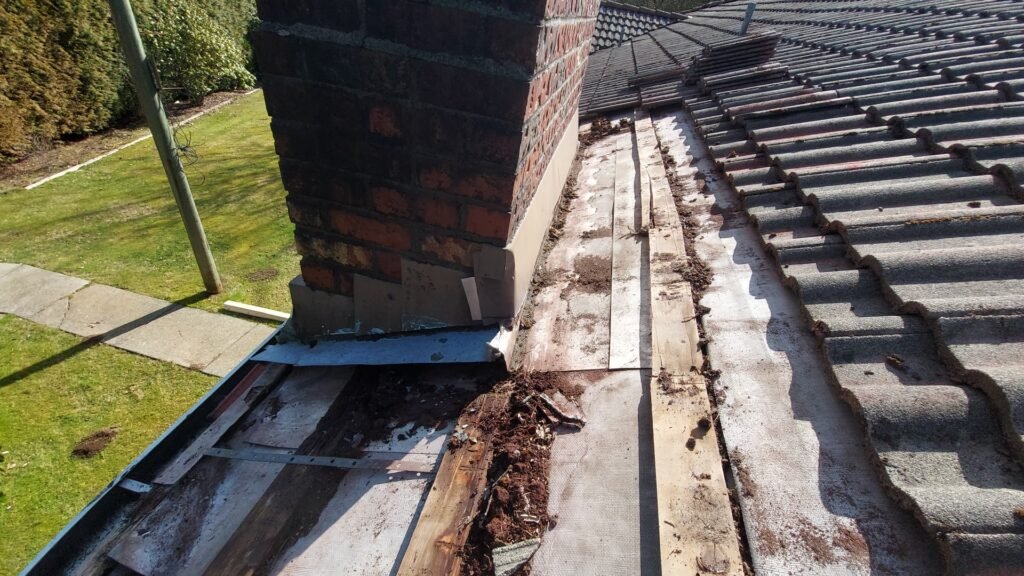
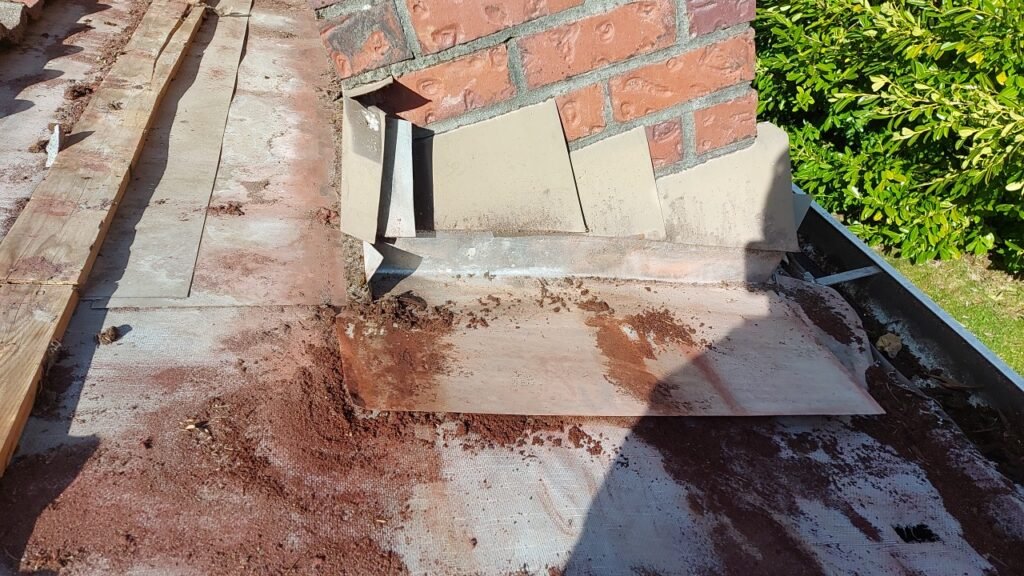
This one gets misdiagnosed more than anything else on the list. It is either handed to a mason as a chimney problem or patched from the top as a roof problem, and half the time it is the other one. Working out which of the two you actually have, before anybody spends money on it, is most of the value here.
Two houses on the same street with the same stain on the same ceiling can turn out to be two different problems. What is actually going on only shows up once someone is up there with the tiles off.
Roof Inspection Report, $500. We get on the roof, find what is actually happening and give you written findings with photos. Book the repair with us and the $500 comes off the job.
It is either the flashing or the masonry, and those are two very different bills. Worth establishing which before anyone starts.
