The most common leak we get called to on a concrete tile roof, for the simple reason that there are more vents up there than anything else, and the originals were plastic.
Every bathroom fan, kitchen fan, furnace and plumbing stack in the house has to vent out through the roof. On a concrete tile roof each one is a separate unit set down into the tile field, with a flat flange that tucks under the tiles above it and lies over the tiles below it, so water runs across it and carries on down the roof.
A typical Lower Mainland tile roof has somewhere between four and a dozen of them. That is the main reason vents are the most common leak on this kind of roof. There are simply more of them than there are skylights, chimneys or valleys.
Most vents installed on tile roofs through the 1980s and 1990s are plastic. Plastic on a roof sits in full ultraviolet light for its entire life, and UV breaks it down. It goes chalky, loses its flexibility and turns brittle. Somewhere past the twenty year mark it starts to crack.
The cracks turn up in two places. The collar, the upstand the duct connects into, splits down its side. And the flange, the flat skirt doing the actual waterproofing, loses its shape, curls at the edge and stops sitting flat on the tile.
On wavy tile it is worse. An S-profile tile is a curve, not a flat plane. A rigid plastic flange has to bridge that curve, and on a lot of these roofs it never sat properly against it even when it was new. Twenty years of UV on a detail that was marginal on day one.
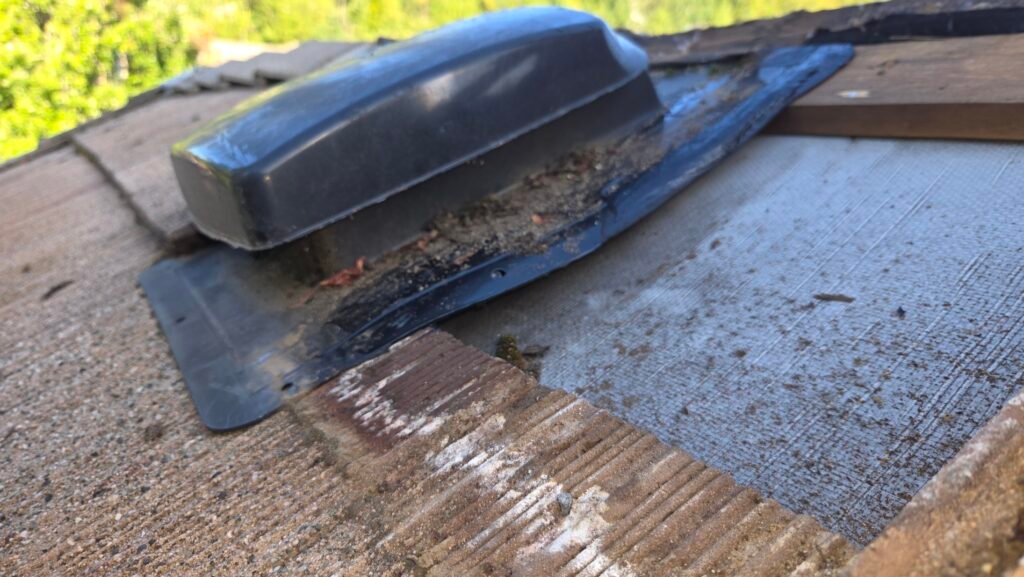

Water getting past a vent flange lands on the underlay, and it lands on the same spot every time it rains. The underlay is the last barrier on the roof and it is the oldest thing up there. The vent is a small part. What it soaks is not.
Two houses on the same street with the same stain on the same ceiling can turn out to be two different problems. What is actually going on only shows up once someone is up there with the tiles off.
Roof Inspection Report, $500. We get on the roof, find what is actually happening and give you written findings with photos. Book the repair with us and the $500 comes off the job.
A vent is the first thing worth ruling out. We will get up there and tell you what is actually going on.
