Most field tiles are not fastened to anything. They hang on a small lug hooked over a timber batten. When the lug snaps or the batten rots, the tile goes for a slide.
Concrete tiles hang. On most tile roofs in this area the field tiles are not nailed or screwed down at all. Each tile has a small lug on its underside called a nib, and that nib hooks over a horizontal timber batten. Gravity and the weight of the tile above do the rest.
That sounds precarious and it is not. It is a proven system and it holds for decades. But it depends on two things staying intact: the nib, and the batten it is hooked over.
The nib snaps off. It is the thinnest part of the tile and it carries the entire load. Or the batten rots, which happens where the underlay beneath has been letting water through for years and keeping the timber permanently damp.
Either way the tile has nothing left to hang on, and it slides down the roof until something stops it, usually the tiles below or the gutter.
Wind does it too. A gust getting under the nose of a tile can lift it clear of the batten and drop it back down out of course.

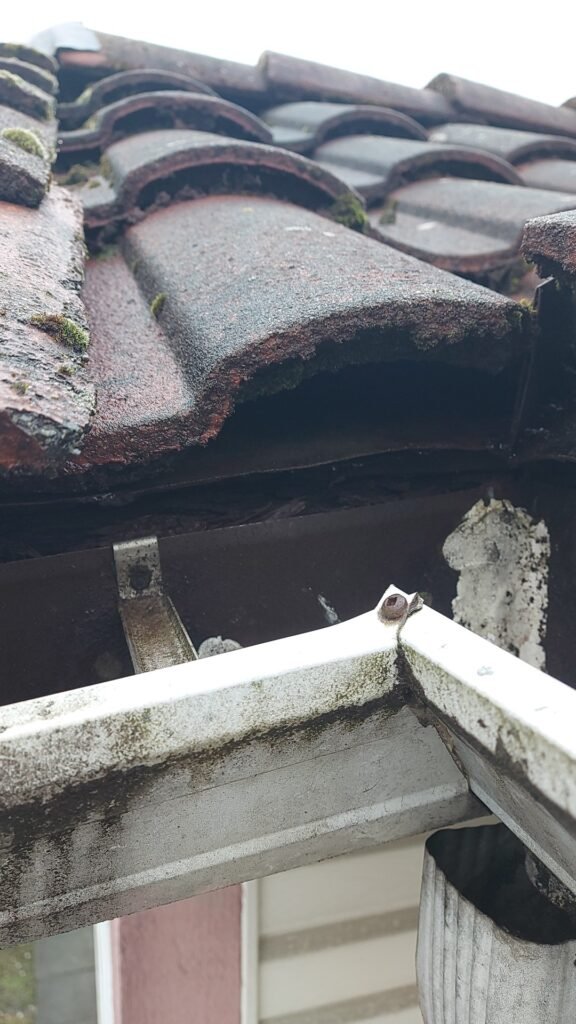
A tile roof keeps water out by overlap. Every tile covers the top portion of the tile below it, and that covered portion is the head lap. The head lap is what stops wind-driven rain being pushed back up under the tiles.
When a tile slides down it uncovers the head lap of the tile below it. So a slipped tile is not just a gap where that tile used to sit. It compromises the tile underneath as well.
The other thing worth knowing: a slipped tile can be the visible symptom of rotten battens, and rotten battens are a bigger conversation than one tile.
Two houses on the same street with the same stain on the same ceiling can turn out to be two different problems. What is actually going on only shows up once someone is up there with the tiles off.
Roof Inspection Report, $500. We get on the roof, find what is actually happening and give you written findings with photos. Book the repair with us and the $500 comes off the job.
Sometimes it is one tile. Sometimes it is the first sign the battens underneath have gone. Worth knowing which.
